Do You Really Need New Ductwork? Repair vs. Replace
Not sure if you really need new ductwork? Learn how we decide when to repair vs. replace, especially in older homes, using real attic inspection examples.
“Do I Really Need New Ductwork?” — A Call From an Older Home
We recently got a call from a homeowner — let’s call her Susan — who lives in an older home built in the early 1970s. She’d just had another company out, and a young salesman showed her some pictures from her attic and tried to sell her an elaborate, high-end duct system with all the bells and whistles.
Susan told us, “I just want basic ductwork that’s not leaking or blown apart. I don’t need infrared this or complicated that. I just want it done right and not pay for stuff I don’t need.” As a local HVAC and ductwork company, we hear this a lot — especially from owners of older homes who can’t easily get into the attic because of allergies, mobility, or just plain fear of heights.
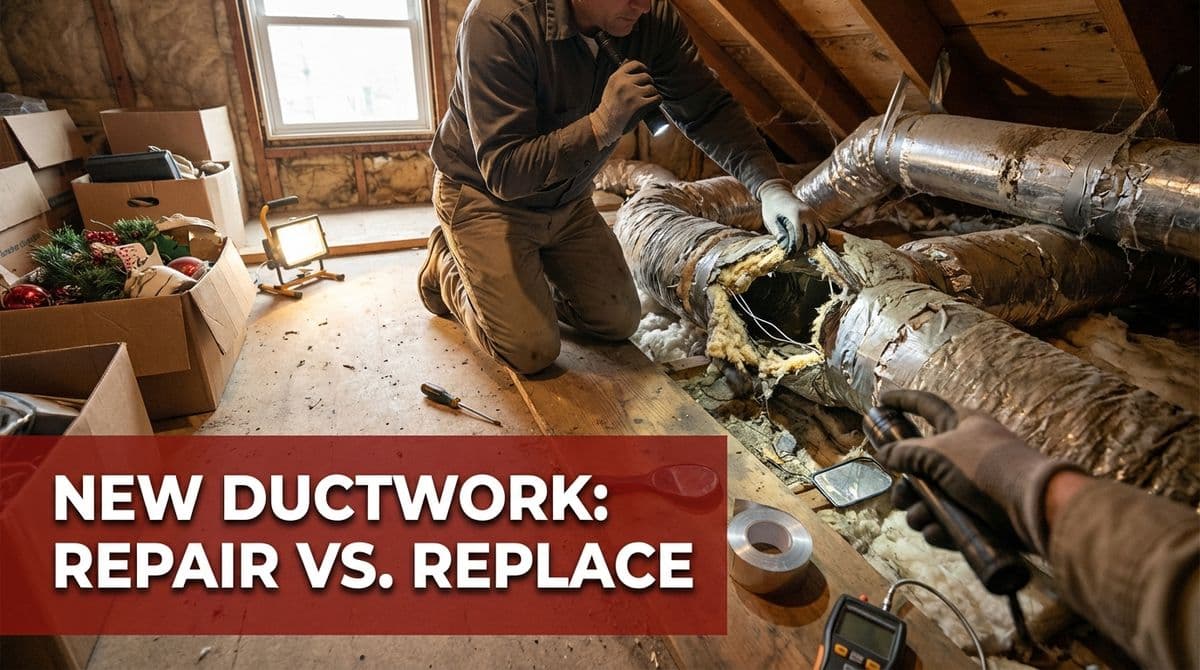
So during that visit, we walked her attic, inspected the ducts, and talked her through the big question: do you really need new ductwork, or can you get by with a repair? Let’s walk through the same thought process we used with Susan so you can make a confident decision in your own home.
First Step: Is Someone Actually Looking in Your Attic?
Susan hadn’t been up in her attic in years. She was relying 100% on the photos and explanation from the first company, and she wasn’t sure if she was getting the whole story. That’s more common than you’d think.
When we come out for a ductwork estimate, we always:
- Physically get into the attic or crawlspace
- Look at every trunk line and branch run, not just the first section we see
- Check how the ducts are connected to the air handler and to each vent
- Look for kinks, crushed sections, and loose or missing insulation
If your contractor isn’t willing to crawl up there, take clear pictures, and explain what you’re seeing, that’s a red flag. You’re the one paying for the work; you deserve to understand the condition of your system.
When Repairing Ductwork Is Usually Enough
In a lot of older homes like Susan’s, the entire duct system doesn’t need to be ripped out. Sometimes a few targeted fixes will get you most of the benefit for a lot less money.
We typically recommend repair instead of full replacement when:
- Leaks are limited to a few joints or connections that can be resealed
- Insulation is mostly intact, with just a few bare or thin spots
- Duct runs are sized correctly and laid out in a reasonable way
- The material itself is sound — not falling apart or brittle with age
Typical repair options include:
- Sealing joints and seams with mastic or proper foil tape (not cloth “duct tape”)
- Re-insulating bare sections to cut down on energy loss and condensation
- Re-hanging sagging ducts so air can flow freely without sharp bends
- Replacing a few bad branches instead of the whole system
With Susan, we knew she wanted to “keep it simple and affordable.” If her ducts had been mostly okay with a few problem spots, that’s exactly the route we would’ve taken.
Clear Signs It’s Time to Replace Your Ductwork
Sometimes, though, repairing is just putting a bandage on a bigger problem. In many 1960s–1980s homes, the original ductwork has simply reached the end of its life. Here are the signs we look for when we recommend full replacement like we were prepared to discuss with Susan:
- Widespread air leaks — multiple disconnected runs, gaps, or blown-apart joints
- Old or failing materials — ducts that are brittle, moldy, or crushed beyond repair
- Very poor design — long, twisting runs, rooms that never get comfortable, or noisy, whistling vents
- Heavy dust and allergy issues that persist even after filter changes and system cleaning
- Hot and cold spots throughout the home, not just in one troublesome room
- Extremely high energy bills compared to similar homes
When we see three or more of these issues at once, it usually makes more sense to invest in new ductwork than to keep patching an old, leaky system. Over time, the energy savings and comfort upgrades can make a big difference.
“I Don’t Want All the Bells and Whistles” — Keeping It Simple
One thing Susan kept repeating was that she was not interested in a fancy, complicated setup. She didn’t want infrared sensors, smart vents, or a system that required an instruction manual just to change a filter.
That’s completely reasonable. A good duct system doesn’t have to be high-tech. For many homeowners, a straightforward design is best:
- Properly sized trunks and branches for each room
- Well-sealed joints and connections
- Properly insulated ducts, especially in a hot attic
- Using existing vents and grilles when they’re in good shape
During our visit, we walked Susan through options that matched her priorities: reliable, basic ductwork first; optional upgrades (like zoning or advanced filtration) as separate, clearly priced add-ons — not “must-haves” pushed into the same quote.
How We Help You Decide: Replace vs. Repair
If you’re in a similar spot — older home, maybe some allergies, not eager to climb a ladder and crawl through insulation — here’s how we typically help homeowners decide:
- Free attic inspection and photos. We show you clear before-and-after pictures so you’re not guessing.
- Explain what’s urgent and what’s optional. We break down safety, comfort, and efficiency issues separately.
- Give you both options when possible. A repair estimate and a replacement estimate, with pros and cons of each.
- Talk in plain language. Just like we did with Susan, we skip the jargon and explain what you’re getting for your money.
Your ductwork is hidden, but the decision about it shouldn’t be a mystery. Whether you choose to repair or replace, you should feel confident you’re not paying for things you don’t actually need.
Wondering About Your Own Ducts?
If your home is a few decades old and you’re worried about leaky, inefficient ducts — or you’ve already had someone try to sell you an expensive “super system” — it might be time for a second opinion.
We’re always happy to come out, put eyes on your ductwork, and walk you through exactly what we see, just like we did for Susan. No pressure, no bells and whistles you didn’t ask for — just an honest assessment of whether repair or replacement makes the most sense for your home.