AC Stopped After Maintenance? Outdoor Fan Not Spinning
AC quit right after a maintenance visit and the outdoor fan isn’t spinning? Learn how we diagnose these calls, what usually fails, and what you can safely check first.
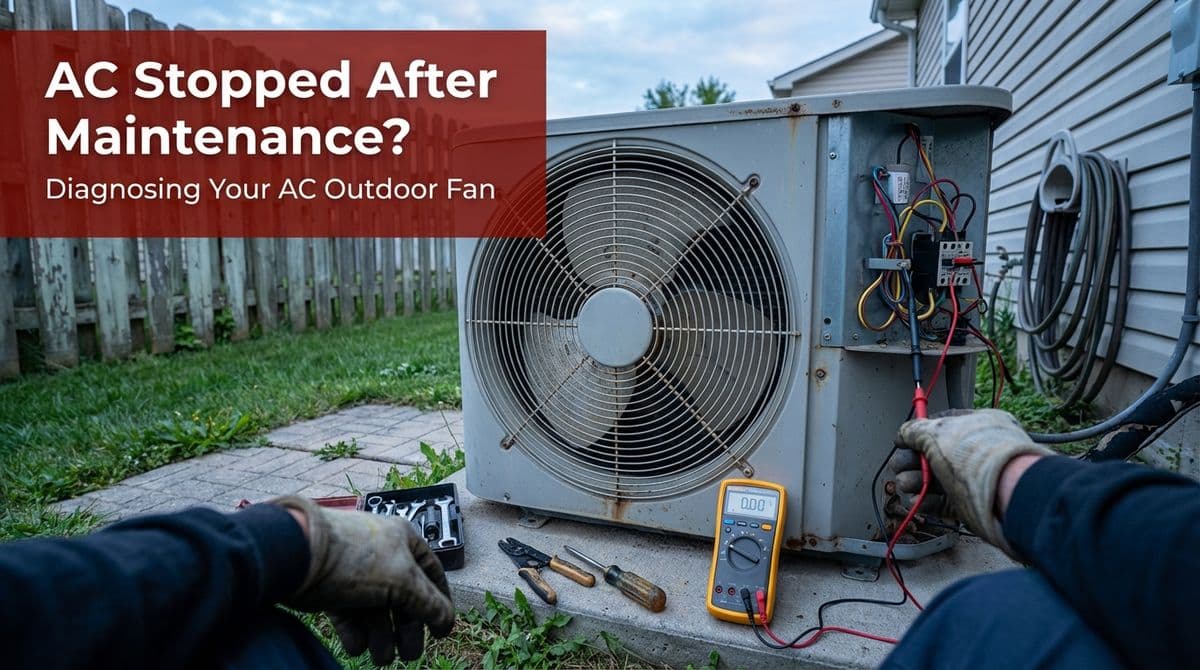
When the AC Dies Right After a Visit: Coincidence or Cause?
We recently got a call from a customer — let’s call him Mark — who was visiting his parents for a birthday dinner. Their air conditioner had been working fine, they’d just had a maintenance visit from another company, and then suddenly… nothing.
By the time Mark called our office, he was hot, frustrated, and more than a little suspicious. The thermostat read 77°F even though it was set to 73°F, the house felt stuffy, and when he walked around to the side of the house, he noticed something that really worried him: the outdoor unit was “about a million degrees to the touch” and the outdoor fan wasn’t spinning at all.
To make it feel even more suspicious, the previous tech had just told his parents there were “pinhole leaks everywhere” and that the system could fail at any moment. Then a short time later, it stopped cooling. Naturally, when something quits right after a maintenance visit, most homeowners call us wondering if someone caused the breakdown.
We see this situation a lot, so we want to walk you through how we look at it, what usually fails, and what you can safely check if your outdoor fan isn’t spinning.
What We Found at Mark’s Parents’ Home
When our technician arrived during the 1–3 PM window we’d scheduled, we started the way we always do: by listening. Mark walked us through the timeline — recent maintenance by another company, warnings about “pinhole leaks,” unit running hot, then the outdoor fan suddenly not spinning.
On site, here’s what we focused on first:
- Thermostat calling for cooling? Yes — the indoor blower was running.
- Outdoor unit energized? We checked for power and low-voltage control signal.
- Fan not spinning? Confirmed: compressor humming, fan still.
- Unit shell hot? The cabinet and top grille were very warm, just like Mark described earlier.
Those signs made us immediately suspect a weak capacitor or a failing fan motor, rather than a refrigerant leak. To be sure, we did what we told Mark on the phone we would do: we put our gauges on the system, checked refrigerant pressures, and tested the capacitor and fan motor with our meters.
In this case, the refrigerant levels were within spec — no obvious sign of a major leak. But the capacitor was out of tolerance, and the fan motor was drawing more amperage than it should. That combination can cause exactly what Mark saw: the compressor trying to run, the top of the unit getting very hot, and the fan either not starting or stopping shortly after it starts.
We replaced the bad parts, monitored the system, and cooling came back. The timing with the previous company’s maintenance was likely a coincidence, but the way it was explained to his parents left them with more fear than clarity — and that’s what we always try to avoid.
Why ACs Often Fail Right After Maintenance
When a system quits after a maintenance visit from any company, most homeowners worry that someone “broke” it. From our side of the fence, here’s what we usually see:
- Components were already near the end of their life and the visit just happened to be close to the failure.
- A weak part (like a capacitor) was stressed as temperatures rose or the system cycled more.
- A legitimate issue was noticed but not clearly explained, so it sounds scarier than it is.
We’re very careful during our own maintenance visits to measure and document things like capacitor values, motor amperage, and refrigerant pressures. If we see something borderline, we show our customers the readings and explain what is urgent and what is just something to watch. That way, if something fails later, it doesn’t feel like a mystery or a “conspiracy.”
Outdoor Fan Not Spinning? Here’s What You Can Safely Check
If you walk outside and your unit is hot and the fan isn’t spinning, there are a few things we talk homeowners through over the phone before we come out. Here’s what you can safely check:
1. Listen and look (without touching)
Stand near the outdoor unit and:
- Listen for a hum or buzz when the thermostat is calling for cooling.
- Look to see if the fan blade is trying to move or is completely still.
- Feel the air coming out of the top from a distance; if it’s barely moving or very hot, shut the system off.
If the compressor is humming but the fan isn’t turning, we strongly recommend turning the system off at the thermostat and calling us. Running a compressor without proper fan cooling can overheat and damage it.
2. Check the obvious power issues
Before we roll a truck, we often ask homeowners to check:
- Breaker panel – Make sure the AC breaker isn’t tripped. If it is, you can reset it once. If it trips again, leave it off and call us.
- Outdoor disconnect – There’s usually a small box near the unit. Ensure the handle or plug hasn’t been pulled out.
Do not open any electrical covers, remove panels, or stick tools inside the unit — at that point, it’s our job.
Common Causes When the Outdoor Fan Won’t Run
From what we see in the field, an outdoor fan that won’t spin (or only starts with a push) is usually one of these:
- Failed or weak capacitor – This is the “start assist” for your fan motor and sometimes the compressor too. When it’s weak, the motor may hum but not start.
- Failing fan motor – Bearings wear, windings overheat, or the motor simply reaches the end of its life.
- Contactor issues – The electrical relay that sends power to the fan and compressor can stick or burn.
- Wiring problems – Loose connections or damaged wires can interrupt power to the fan.
We diagnose these with proper meters and test equipment. In Mark’s parents’ case, once we replaced the failed electrical components and verified operation, the unit cooled normally and the outdoor cabinet no longer felt like a stovetop.
Was That Talk About “Pinhole Leaks” Legit?
Mark was understandably skeptical when the previous company mentioned pinhole leaks “everywhere.” We hear that kind of language a lot, and we always try to be more precise when we talk to our customers.
Here’s how we handle suspected leaks during our own maintenance calls:
- We check refrigerant pressures and superheat/subcooling, not just “feel” the lines.
- If levels are off, we look for oil stains, corrosion, or visible damage at the coil and connections.
- When necessary, we perform a leak search with appropriate tools, then show you what we find.
We don’t use vague, scary terms to push replacement. If there really is a coil leak or multiple leaks, we show you photos or readings and explain your options clearly.
What a Good Maintenance Visit Should Include
To help avoid the kind of surprise Mark’s parents experienced, here’s what we build into our regular AC maintenance visits:
- Electrical checks – Capacitor values, motor amperage, contactor condition, and wiring inspection.
- Refrigerant performance check – Pressures and temperature readings to verify proper charge.
- Safety and system checks – Thermostat operation, drain line, filter condition, and overall airflow.
- Clear, written findings – We note anything marginal or aging so you can plan ahead.
Our goal is for you to feel informed, not pressured. If we see something that might fail in the near future, we explain what it does, how urgent it is, and what it costs to address now versus later.
How to Choose a Trustworthy AC Company
Mark found us through a family recommendation, which we always appreciate. When people call us after a bad experience with another provider, we suggest they look for a company that:
- Explains findings in plain language and is willing to answer questions.
- Shows readings or photos instead of just making scary claims.
- Offers options (repair vs. replace) instead of one “take it or leave it” solution.
- Doesn’t pressure you to cancel family plans or rush decisions unless there’s a real safety concern.
In Mark’s case, we worked around his dad’s birthday dinner, scheduled a convenient window for the next day, and got the system cooling again without turning it into a high-pressure situation.
Bottom Line: Don’t Ignore a Hot, Silent Outdoor Unit
If your AC suddenly stops cooling after a maintenance visit and your outdoor fan isn’t spinning, it may be coincidence — but it’s still a problem that needs attention. Turn the system off, check the basics (thermostat and breakers), and then let us handle the rest.
We’ll do what we did for Mark’s family: show up when we say we will, check refrigerant levels and electrical components, explain what we find, and help you decide the best, most honest way to get your home comfortable again.