AC Replacement Cost for a 1,500 Sq. Ft. Home (Phone Quotes)
Wondering what it costs to replace an AC in a 1,500 sq. ft. home? Learn real-world price factors, repair vs. replace tips, and why phone quotes are only estimates.
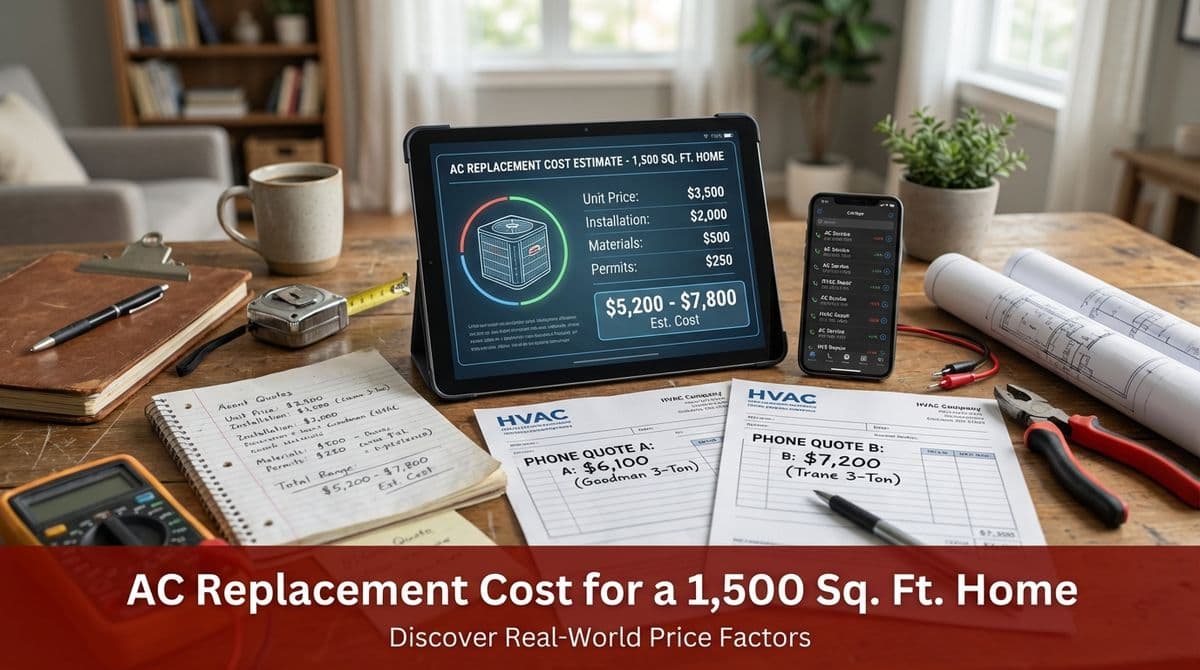
Phone Call Story: “Can You Just Give Me a Ballpark Price?”
We recently got a call from a homeowner — let’s call him Mark — who owns a 1,500 sq. ft. modular home here in Central Florida. His air conditioner is about nine years old, a Goodman system, and he’d just had another company out to repair it. After looking things over himself, he felt like he might be getting the runaround and started calling around for honest pricing from a family-owned company.
Mark’s question was simple: “Can you give me a general price over the phone to replace my AC in a 1,500 square foot modular home?”
We hear that exact question a lot, and it’s a fair one — especially if you’re planning ahead, like Mark, who spends part of the year up north and wanted to know what he might be in for if his system failed when he returned.
So let’s walk through what we told him: roughly how much it can cost to replace an AC in a 1,500 sq. ft. home, what affects that price, and why phone quotes are always estimates, not exact numbers.
Typical AC Replacement Cost for a 1,500 Sq. Ft. Home
Every home and system is different, but for a standard 1,500 sq. ft. home in Florida, a typical full AC replacement (condenser and air handler) might land in a range like:
- Budget/basic systems: lower upfront cost, basic efficiency
- Mid-range systems: better efficiency and comfort features
- High-efficiency/advanced systems: variable speed, humidity control, quieter operation, and lower utility bills long-term
Where you land in that spectrum depends on what matters most to you: lowest upfront cost, lowest long-term operating cost, or the best balance of both.
When Mark called, the first thing we did — just like in the transcript above — was confirm his home size and type (1,500 sq. ft. modular home) and location. That gave our technician enough information to offer a ballpark over the phone, but not a final quote.
Why We Can’t Give Exact AC Prices Over the Phone
Mark understood something a lot of folks don’t at first: a phone quote is always a guesstimate. He ran his own service business for 30 years, so he knew we couldn’t be pinned down to an exact number without seeing the system.
Here’s why an in-person visit matters so much:
- Correct system size: 1,500 sq. ft. is a good starting point, but insulation, ceiling height, sun exposure, number of windows, and air leakage all affect the size you actually need. Oversized or undersized systems waste money and cause comfort issues.
- Ductwork condition: Leaky, undersized, or poorly designed ductwork can kill efficiency and comfort. Sometimes we can reuse ducts; other times they need repairs or modifications, which affects price.
- Electrical and drain lines: Older homes may need electrical upgrades, new disconnects, or updated drain lines to meet code and manufacturer requirements.
- Access and installation difficulty: Tight closets, attic access, or modular construction details can increase labor time.
- Brand and efficiency choice: SEER rating, single-stage vs. two-stage or variable-speed, and indoor air quality add-ons all change the final number.
Because of all this, what we offer over the phone is a range to help you budget. Then we follow up with a free in-home estimate (like we offered Mark) to confirm the right system and provide a written, accurate quote.
How Long Should an AC Last in a 1,500 Sq. Ft. Florida Home?
Mark’s Goodman system was about nine years old. His big question was whether he should just keep repairing it or start budgeting for replacement.
In Florida’s heat and humidity, most central AC systems last about:
- 10–15 years on average with decent maintenance
- 8–12 years if poorly maintained or heavily undersized/oversized
So at nine years old, his system is approaching that point where major components (like the compressor or coil) may start to fail more often. That’s exactly when it makes sense to compare repair vs. replacement numbers.
Repair vs. Replace: How to Decide
Homeowners in Mark’s situation often ask us, “Should I keep fixing this thing or just bite the bullet and replace it?” We usually walk them through a few simple guidelines:
- Age of the system: If it’s under 8 years old, a repair usually makes sense unless it’s a major failure. Over 10–12 years, replacement becomes more attractive.
- Cost of the repair: Many pros use a rule of thumb: if the repair is more than 30–40% of the cost of a new system, and the unit is nearing the end of its life, replacement is often smarter.
- Frequency of breakdowns: One repair in a couple of years isn’t a big deal. Several repairs in one or two seasons is a sign the system is on borrowed time.
- Comfort and utility bills: If some rooms are always hot, the unit runs nonstop, or your power bill keeps climbing, a higher-efficiency system can pay you back over time.
When we do a free estimate, we’re happy to show you the math both ways: keep repairing vs. replace now, including estimated energy savings with a newer, more efficient system.
Why Working With a Local, Family-Owned Company Matters
Like Mark, a lot of homeowners are wary of large, private-equity-owned HVAC companies. They’ve heard stories about high-pressure sales, confusing pricing, or feeling like they’re just a number.
As a family-owned, veteran-owned company, we try to keep things simple:
- Clear communication: We’ll give you a realistic phone range, then a detailed written quote after we see the home.
- No high-pressure sales: Our job is to educate you, not push you into replacing a system that still makes sense to repair.
- Options, not ultimatums: We usually present a good/better/best set of options so you can choose what fits your budget and comfort goals.
That’s the same approach we took with Mark: rough numbers over the phone so he could plan ahead, followed by an offer for a free in-person estimate if and when he was ready.
Next Step: Get a Free, In-Home AC Replacement Estimate
If you’re like Mark — sitting on a 1,500 sq. ft. home with an aging system and wondering what replacement might cost — a quick phone call can absolutely give you a helpful ballpark range.
Just remember: until we’ve seen your home, checked your ducts, and sized the equipment correctly, that number is only an estimate. The good news is, we’re happy to come out, take a thorough look, and provide a free, no-obligation written quote so you can make a confident decision about your next AC system.