AC Blowing but Not Cooling? Causes and When to Call
AC blowing but not cooling? Learn the most common causes, what you can safely check yourself, and when it’s smart to call for emergency AC service.
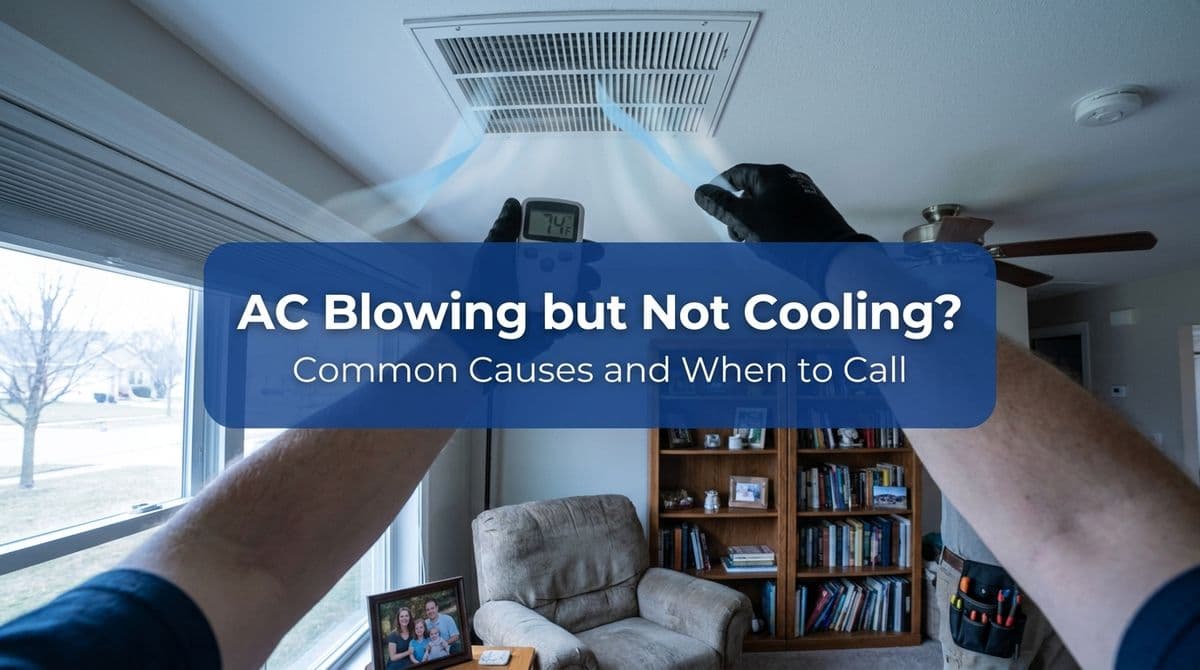
When Your AC Is Blowing but the House Still Feels Hot
We recently got a late-night call from a customer — let’s call him Mark — who sounded exhausted. He works very early mornings and had just come home to a home that felt like an oven. His air conditioner was running and the vents were blowing air, but the air wasn’t cold at all.
Mark was hoping for 24-hour emergency service because it was a brutally hot night and he was worried something major had failed. We’d already booked our techs out for the evening, so we walked him through a few things he could safely check before his appointment the next day.
If you’re in the same boat — AC blowing but not cooling — this is one of the most common calls we get. Let’s walk through what might be happening, what you can check yourself, and when it really is time to call for emergency service.
First Question: Is the Fan Blowing but Air Is Warm?
On the phone, we asked Mark the same question we ask every customer in this situation: “Is the fan still blowing something out of the vents?” He said yes — there was plenty of airflow, just no cold air.
That detail matters. If the fan is running but you’re only getting room-temperature or warm air, it usually means:
- The indoor blower is working
- The outdoor unit or cooling side of the system is having an issue
In other words, the part that moves air is alive; the part that makes it cold is struggling.
Common Reasons Your AC Is Blowing but Not Cooling
There are a handful of frequent causes we see in homes like Mark’s, especially during very hot weather:
- Dirty air filter restricting airflow over the evaporator coil
- Frozen indoor coil (often from low airflow or low refrigerant)
- Outdoor unit (condenser) not running even though the indoor fan is
- Tripped breaker to the outdoor unit
- Refrigerant issues (leaks or low charge)
- Thermostat problems (wrong mode or faulty thermostat)
Some of these you can safely check yourself; others really do need a licensed HVAC technician with proper tools and gauges.
What You Can Safely Check Before We Arrive
When we booked Mark for a next-day appointment, we walked him through a quick checklist. You can follow the same steps:
1. Check Your Thermostat Settings
- Make sure the thermostat is set to “Cool”, not “Heat” or “Fan Only.”
- Set the fan to “Auto”, not just “On,” so the system cycles properly.
- Lower the set temperature a few degrees below the current room temperature.
It sounds simple, but we do run a surprising number of calls where the thermostat mode was bumped accidentally.
2. Look at (and Listen to) the Outdoor Unit
Step outside and safely observe your outdoor unit:
- Is the fan on top spinning?
- Can you hear the compressor running (a deeper humming sound)?
- Is the unit completely quiet while the indoor fan is blowing?
If the indoor fan is running but the outdoor unit is silent, that’s a big clue. It could be a tripped breaker, a bad capacitor, or a failed contactor — all common issues we see in the summer heat.
3. Check Your Breakers
Go to your electrical panel and look for breakers labeled “AC,” “Air Conditioner,” or “Condenser” and:
- See if any breaker is in the middle or “tripped” position.
- If it is, switch it fully off, then back on once.
If it trips again immediately, do not keep resetting it. That’s a sign of an electrical problem that needs professional attention.
4. Inspect and Replace the Air Filter
We also asked Mark when he’d last changed his filter. A clogged filter can cause the indoor coil to get too cold and ice over, which leads to weak or warm airflow.
- Locate your return-air filter (usually at the indoor unit or behind a large grille).
- Slide it out and hold it up to the light — if you can’t see light through it, it’s time to change it.
- Install a new filter with the arrow pointing in the direction of the airflow.
If you suspect the coil is frozen (you see ice on the copper lines or the unit), turn the system to “Off” but turn the fan to “On” for a few hours to help it thaw. Running it frozen can damage the compressor.
When It’s Time to Call for Emergency AC Service
Not every “blowing but not cooling” situation is an emergency, but sometimes waiting is risky or unsafe. We recommend calling for emergency service if:
- The indoor temperature is extremely high and you have young children, elderly family members, or health issues in the home.
- You smell burning, melting plastic, or electrical odors from the unit or vents.
- You see smoke or signs of arcing at the equipment or breaker panel.
- The outdoor unit makes loud grinding, screeching, or banging noises.
- A breaker keeps tripping when the AC tries to start.
In those cases, shut the system down at the thermostat and breaker, and then call for emergency service. It’s not worth damaging expensive components — or risking safety — by forcing it to run.
What We Do on a Service Call Like This
During Mark’s scheduled visit window, our technician would perform a full system check, which typically includes:
- Verifying thermostat operation and wiring
- Checking breakers, capacitors, contactors, and electrical connections
- Inspecting the air filter and indoor coil for dirt or ice
- Confirming the outdoor unit is running correctly
- Measuring refrigerant pressures and temperatures
- Looking for signs of leaks or component failure
Sometimes the fix is simple — a failed capacitor, a clogged filter, or a minor electrical component. Other times we uncover a refrigerant leak or a failing compressor. Either way, our goal is to explain what we find in plain language, review your options, and get you back to a cool home as quickly and safely as possible.
Don’t Ignore an AC That’s Running but Not Cooling
If your system is blowing air but not cooling, you don’t have to panic, but you also shouldn’t ignore it. Try the basic checks above, and if the problem doesn’t resolve, schedule a visit so we can get to the bottom of it.
We’ll always be honest about whether it’s a simple repair, a sign of a larger issue, or a situation that truly calls for emergency attention — and we’ll walk you through every step, just like we did for Mark.